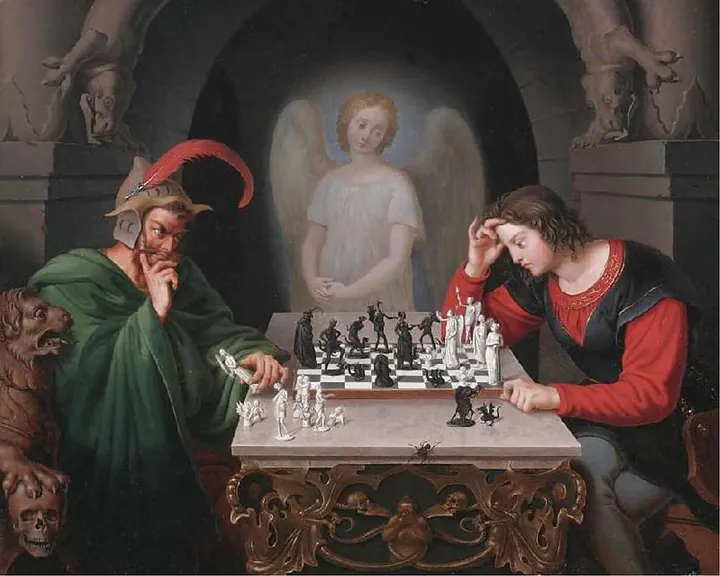
Check Mate (The Chess Players) / Faust and Mephistopheles Playing Chess for a Soul
A Romantic allegorical painting depicting a chess game between a young man and the devil Mephistopheles, with a human soul as the stake. A guardian angel watches over the young player from behind, glowing ethereally. The chess pieces themselves are figurative—black demonic figures versus white robed figures—turning the board into a battleground for the soul.
The image draws on the Faust legend popularized by Goethe in the early 19th century, a central theme of German Romanticism. Moritz Retzsch was renowned for his outline illustrations to Goethe's 'Faust.' This famous composition, often titled 'Check Mate' or 'The Chess Players,' became iconic and inspired the legend that a chess master once found a winning move that the devil had missed—proving the game was never truly lost.
Retzsch worked in a precise, linear Romantic style influenced by Northern Renaissance painting. The detailed chiaroscuro, the niche architecture, and the figural chess set echo Dürer and Cranach, blending moralizing allegory with theatrical narrative typical of German Romantic art.
Visual Analysis
The composition is symmetrical and stage-like. On the left, Mephistopheles in red-feathered cap and green cloak leans forward confidently, a lion and grotesque skull-faced creature beside him. On the right, the young man rests his head in despair, contemplating the board. Between them rises the white-robed angel, luminous and serene. The carved Baroque table base displays grotesque masks and skulls, reinforcing the theme of mortality.
The chess game symbolizes the cosmic struggle for the human soul. Black pieces represent evil/damnation, white represent virtue/salvation. The angel signifies divine grace and hope. Skulls and demonic carvings represent death and hell awaiting the loser. The young man's anguished pose suggests he believes himself defeated.
The work conveys that no soul is ever truly lost while divine grace stands watch. The legend attached to it—that there exists a saving move the devil overlooked—turns despair into hope, embodying the Romantic and Christian belief in redemption.
Chess historians and clergy have long debated the actual board position; some claim the young man is not actually in checkmate. The painting reportedly inspired American chess master Paul Morphy, who allegedly found the 'winning move.'