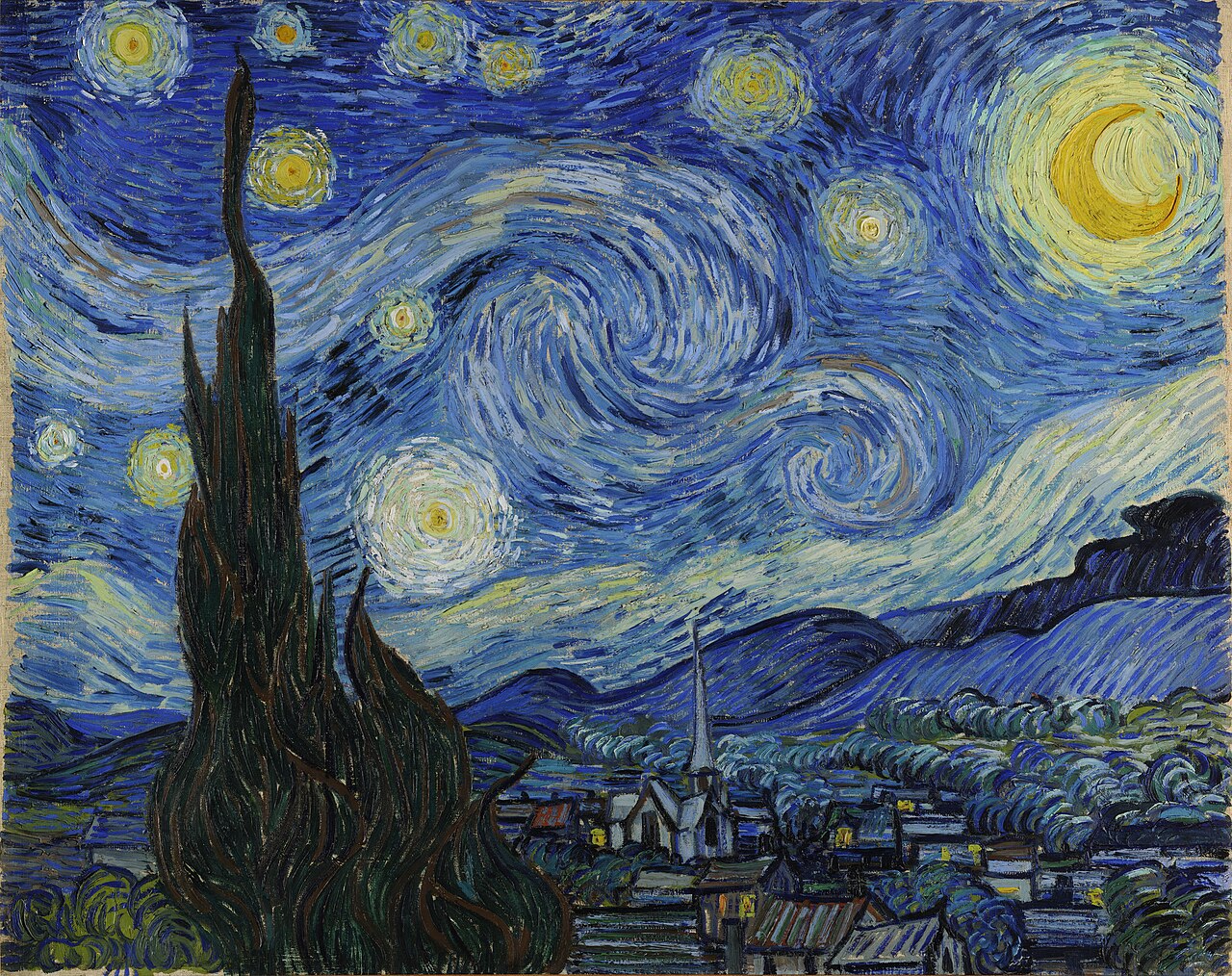
The Starry Night
The Starry Night is one of the most iconic paintings in Western art, depicting a swirling, turbulent night sky over a quiet village. Painted by Vincent van Gogh in June 1889, it portrays the view from his asylum room window at Saint-Rémy-de-Provence, enhanced by his imagination and emotional intensity. The work is celebrated for its dynamic brushwork, vivid contrasts of blue and yellow, and profound expressive power.
Van Gogh painted The Starry Night while voluntarily residing at the Saint-Paul-de-Mausole asylum in Saint-Rémy-de-Provence, southern France, following his breakdown and the infamous ear-mutilation incident in Arles. The late 1880s were a period of intense productivity despite his mental suffering. This was a transitional era in European art, with artists breaking from realism and Impressionism to pursue more subjective and emotional modes of expression.
The painting exemplifies Post-Impressionism, a movement that emphasized symbolic content, emotional resonance, and structural form over the fleeting naturalism of Impressionism. Van Gogh's bold, impasto brushstrokes and non-naturalistic color choices anticipated Expressionism and influenced 20th-century modern art. His work diverged from his contemporaries through its raw emotional directness and energetic, rhythmic application of paint.
Visual Analysis
The composition is dominated by a vast, swirling sky rendered in undulating spirals of blue, broken by radiant orbs of yellow and white representing stars and a crescent moon. A dark cypress tree anchors the left foreground, rising flame-like into the sky and connecting earth to heaven. Below, a tranquil village with a prominent church spire nestles among rolling hills. Van Gogh employs thick impasto, dramatic curvilinear movement, and complementary color contrasts of blue and orange-yellow to generate visual energy and emotional tension.
The cypress tree, traditionally associated with death and mourning in Mediterranean culture, may symbolize a bridge between life and death, the earthly and the eternal. The turbulent sky reflects van Gogh's inner emotional turmoil, while the peaceful village suggests order and human refuge. The brilliant celestial bodies evoke themes of spirituality, infinity, and the search for transcendence amid suffering.
The Starry Night can be read as a deeply personal expression of van Gogh's psychological state and his yearning for hope and spiritual meaning during a period of confinement and illness. The contrast between the chaotic, animated heavens and the still village embodies a tension between turmoil and serenity, despair and faith. Many interpret the painting as van Gogh's attempt to find consolation and the divine in nature and the cosmos.
The village depicted is largely imaginary, as van Gogh could not see a town from his asylum window; the church steeple resembles those of his native Netherlands rather than southern France. Van Gogh painted this scene from memory and imagination during the day. He himself was somewhat dissatisfied with the work. The swirling patterns have been studied by physicists for their resemblance to mathematical models of turbulence. The painting now resides in the Museum of Modern Art (MoMA) in New York.